
Digital Signing of Physical Items Protocol
A cryptographic protocol for authenticating packages using digitally signed QR codes. Privacy-preserving delivery, anti-cloning protection, and cryptographic proof of delivery for shipping and logistics.
The Digital Envelope Model
DSPIP follows a "digital envelope" paradigm for shipping labels. The envelope exterior (sender identity, last mile provider destination, tracking number) is publicly readable for routing. A cryptographic signature proves the label was created by the claimed sender and hasn't been tampered with. The actual recipient address and delivery instructions are encrypted for the last mile provider only.
This model protects recipient privacy while maintaining package routability. Using DNS-based public key distribution (like DKIM for email), DSPIP enables decentralized verification without requiring a central authority.
Design Goals
Cryptographic Auth
Verify package origin through digital signatures
Privacy Preservation
Encrypted recipient info during transit
Anti-Cloning
Physical binding prevents QR duplication
Decentralized
No central authority for validation
Offline Capable
Verify without network connectivity
Delivery Confirmation
Cryptographic proof of successful delivery
Scalable Operations
Efficient revocation and confirmation systems
Standards Compliant
Integrates with existing logistics systems
Cost Effective
Near-zero marginal cost per package
Blockchain Optional
Can integrate but operates independently
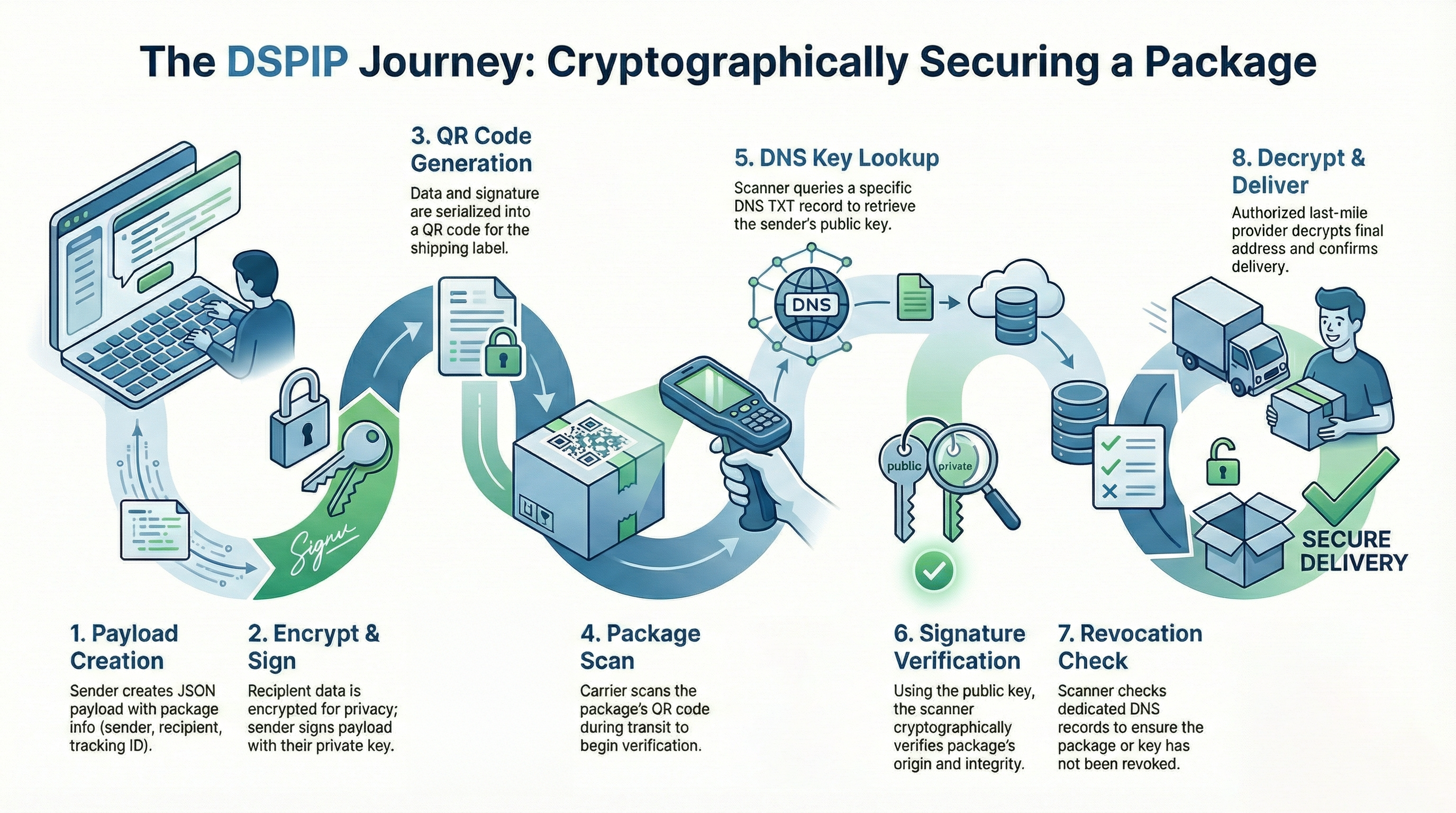
Technical Specifications
How It Works
- Create Payload: Sender creates shipping payload with sender info, last mile provider, tracking number, and timestamp
- Select Privacy Mode: Choose standard, encrypted, or split-key mode based on security requirements
- Encrypt Recipient: For privacy modes, encrypt recipient information with last mile provider's public key
- Sign & Encode: Sign payload with private key (or label key for split-key mode) and generate QR code
- Transit Scanning: Carriers scan QR at each custody transfer, verify signature via DNS lookup
- Privacy Decryption: Last mile provider decrypts recipient info using their private key
- Delivery: Package delivered to actual recipient with cryptographic confirmation
- Optional Blockchain: Custody chain recorded for immutable audit trail
Privacy Modes
Legacy Compatibility
- Full recipient info visible
- Traditional shipping workflow
- Business-to-business shipments
Privacy-Preserving
- Recipient encrypted with ECIES
- Only last mile provider can decrypt
- Consumer privacy protection
- Carrier notes encrypted
Maximum Security
- Physical anti-cloning labels
- Ed25519 key pairs in scratch-off zones
- Offline verification
- High-value shipments
Security Features
Attack Prevention
- Package forgery - cryptographic signatures
- QR code cloning - split-key labels
- Recipient privacy breach - encryption
- Delivery fraud - cryptographic proof
Secure Operations
- HSM for shipping keys
- Annual key rotation
- Emergency revocation
- Split-key one-time-use
Delivery Proof
- Challenge-response protocol
- Single-use delivery keys
- Multi-party attestation
- Location verification
Built on Established Standards
DSPIP builds upon established standards while introducing shipping-specific features. Organizations can integrate DSPIP with existing logistics systems for enhanced authentication:
- RFC 6376 (DKIM): DNS-based public key distribution model
- GS1 EPCIS: Adds cryptographic authentication to event-based visibility
- EDI 856 (ASN): Enables verification without central database
- ISO 18004: QR code standards for label encoding
- ECIES: Elliptic Curve Integrated Encryption for recipient privacy
- Blockchain Networks: secp256k1 keys compatible with Bitcoin/Ethereum